CompletableFuture的5大坑!
CompletableFuture在并发编程中非常实用,但如果用不好,也很容易踩坑。
今天这篇文章跟大家一起聊聊,CompletableFuture在使用过程中最常见的那些坑,希望对你会有所帮助。
一、CompletableFuture简介
有些小伙伴在工作中刚开始接触CompletableFuture时,可能会被它强大的功能所吸引。
确实,CompletableFuture为我们提供了非常优雅的异步编程方式,但正如武侠小说中的神兵利器,如果使用不当,反而会伤到自己。
CompletableFuture的基本用法
先来看一个简单的CompletableFuture使用示例:
public class BasicCompletableFutureDemo {
public static void main(String[] args) throws Exception {
    // 简单的异步计算
    CompletableFuture<String> future = CompletableFuture.supplyAsync(() -> {
        // 模拟耗时操作
        try {
            Thread.sleep(1000);
        } catch (InterruptedException e) {
            e.printStackTrace();
        }
        return "Hello, CompletableFuture!";
    });

    // 获取结果(阻塞)
    String result = future.get();
    System.out.println(result);
}
}
看起来很简单对吧?但正是这种表面上的简单,掩盖了很多潜在的复杂性。
让我们通过一个架构图来理解CompletableFuture的完整生态:
现在,让我们开始深入探讨各个坑点。
二、线程池使用不当
有些小伙伴在使用CompletableFuture时,往往忽略了线程池的配置,这可能是最容易被忽视但影响最大的坑。
默认线程池的陷阱
public class ThreadPoolPitfall {
// 危险的用法:大量使用默认线程池
public void processBatchData(List<String> dataList) {
    List<CompletableFuture<String>> futures = new ArrayList<>();

    for (String data : dataList) {
        // 使用默认的ForkJoinPool.commonPool()
        CompletableFuture<String> future = CompletableFuture.supplyAsync(() -> {
            return processData(data);
        });
        futures.add(future);
    }

    // 等待所有任务完成
    CompletableFuture.allOf(fatures.toArray(new CompletableFuture[0]))
                    .join();
}

private String processData(String data) {
    // 模拟数据处理
    try {
        Thread.sleep(100);
    } catch (InterruptedException e) {
        Thread.currentThread().interrupt();
    }
    return data.toUpperCase();
}
}
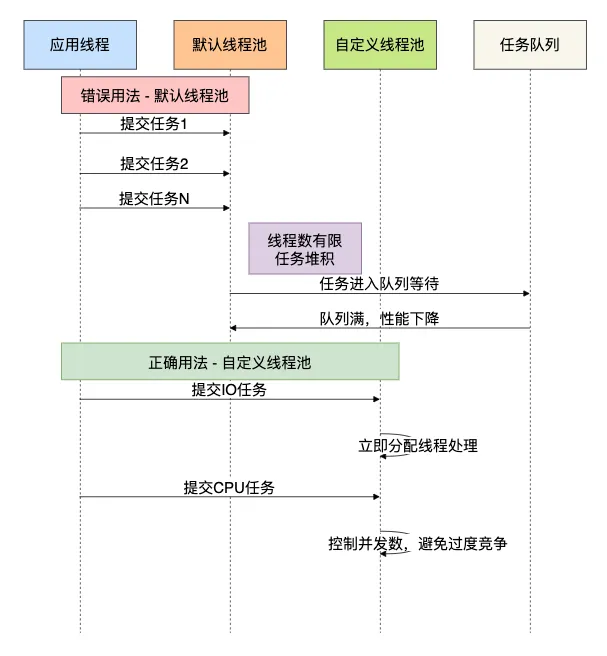
问题分析:
默认线程池大小是CPU核心数-1
在IO密集型任务中,这会导致大量任务排队等待
如果任务提交速度 > 任务处理速度,会造成内存溢出
正确的线程池使用方式
public class ProperThreadPoolUsage {
private final ExecutorService ioBoundExecutor;
private final ExecutorService cpuBoundExecutor;

public ProperThreadPoolUsage() {
    // IO密集型任务 - 使用较大的线程池
    this.ioBoundExecutor = new ThreadPoolExecutor(
        50, // 核心线程数
        100, // 最大线程数
        60L, TimeUnit.SECONDS, // 空闲线程存活时间
        new LinkedBlockingQueue<>(1000), // 工作队列
        new ThreadFactoryBuilder().setNameFormat("io-pool-%d").build(),
        new ThreadPoolExecutor.CallerRunsPolicy() // 拒绝策略
    );

    // CPU密集型任务 - 使用较小的线程池
    this.cpuBoundExecutor = new ThreadPoolExecutor(
        Runtime.getRuntime().availableProcessors(), // CPU核心数
        Runtime.getRuntime().availableProcessors() * 2,
        60L, TimeUnit.SECONDS,
        new LinkedBlockingQueue<>(100),
        new ThreadFactoryBuilder().setNameFormat("cpu-pool-%d").build(),
        new ThreadPoolExecutor.AbortPolicy()
    );
}

public CompletableFuture<String> processWithProperPool(String data) {
    return CompletableFuture.supplyAsync(() -> {
        // IO操作,使用IO线程池
        return fetchFromDatabase(data);
    }, ioBoundExecutor);
}

public CompletableFuture<String> computeWithProperPool(String data) {
    return CompletableFuture.supplyAsync(() -> {
        // CPU密集型计算,使用CPU线程池
        return heavyComputation(data);
    }, cpuBoundExecutor);
}

// 资源清理
@PreDestroy
public void destroy() {
    ioBoundExecutor.shutdown();
    cpuBoundExecutor.shutdown();
    try {
        if (!ioBoundExecutor.awaitTermination(5, TimeUnit.SECONDS)) {
            ioBoundExecutor.shutdownNow();
        }
        if (!cpuBoundExecutor.awaitTermination(5, TimeUnit.SECONDS)) {
            cpuBoundExecutor.shutdownNow();
        }
    } catch (InterruptedException e) {
        ioBoundExecutor.shutdownNow();
        cpuBoundExecutor.shutdownNow();
        Thread.currentThread().interrupt();
    }
}
}
线程池工作流程对比
三、异常为什么神秘消失了?
有些小伙伴在调试CompletableFuture时,经常会发现异常"神秘消失"了,这其实是CompletableFuture异常处理机制的一个特性。
异常丢失的典型案例
public class ExceptionDisappearance {
public void testExceptionLost() {
    CompletableFuture<String> future = CompletableFuture.supplyAsync(() -> {
        // 这里会抛出异常
        return dangerousOperation();
    });

    // 添加转换链
    CompletableFuture<String> resultFuture = future.thenApply(result -> {
        System.out.println("处理结果: " + result);
        return result + " processed";
    });

    try {
        // 这里不会抛出异常!
        String result = resultFuture.get();
        System.out.println("最终结果: " + result);
    } catch (Exception e) {
        // 异常被包装在ExecutionException中
        System.out.println("捕获到异常: " + e.getClass().getName());
        System.out.println("根本原因: " + e.getCause().getMessage());
    }
}

private String dangerousOperation() {
    throw new RuntimeException("业务操作失败!");
}

// 更隐蔽的异常丢失
public void testHiddenExceptionLoss() {
    CompletableFuture.supplyAsync(() -> {
        throw new BusinessException("重要异常");
    }).thenAccept(result -> {
        // 如果上游有异常,这里不会执行
        System.out.println("处理结果: " + result);
    });

    // 程序继续执行,异常被忽略!
    System.out.println("程序正常结束,但异常丢失了!");
}

static class BusinessException extends RuntimeException {
    public BusinessException(String message) {
        super(message);
    }
}
}
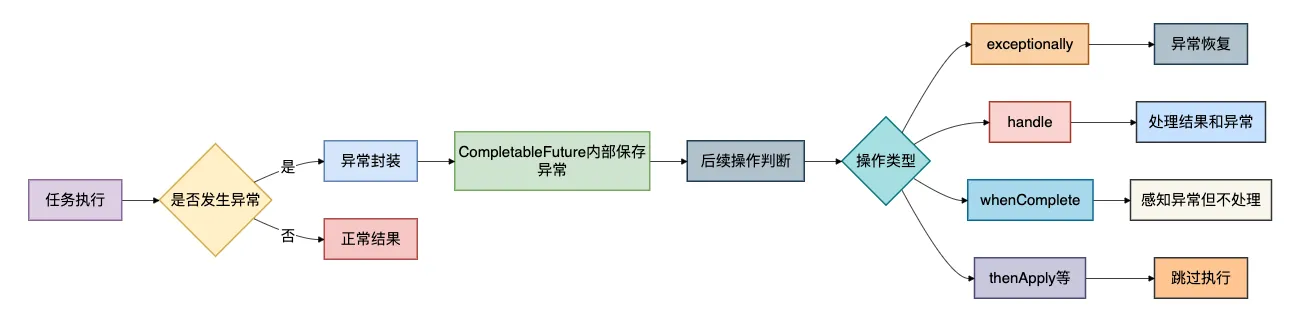
CompletableFuture异常处理机制
正确的异常处理方式
public class ProperExceptionHandling {
// 方法1:使用exceptionally进行恢复
public CompletableFuture<String> handleWithRecovery() {
    return CompletableFuture.supplyAsync(() -> {
        return riskyOperation();
    }).exceptionally(throwable -> {
        // 异常恢复
        System.err.println("操作失败,使用默认值: " + throwable.getMessage());
        return "default-value";
    });
}

// 方法2:使用handle统一处理
public CompletableFuture<String> handleWithUnified() {
    return CompletableFuture.supplyAsync(() -> {
        return riskyOperation();
    }).handle((result, throwable) -> {
        if (throwable != null) {
            // 处理异常
            System.err.println("操作异常: " + throwable.getMessage());
            return "error-value";
        }
        return result + "-processed";
    });
}

// 方法3:使用whenComplete进行副作用处理
public CompletableFuture<Void> handleWithSideEffect() {
    return CompletableFuture.supplyAsync(() -> {
        return riskyOperation();
    }).whenComplete((result, throwable) -> {
        if (throwable != null) {
            // 记录日志、发送告警等
            logError(throwable);
            sendAlert(throwable);
        } else {
            // 正常业务处理
            processResult(result);
        }
    });
}

// 方法4:组合操作中的异常处理
public CompletableFuture<String> handleInComposition() {
    CompletableFuture<String> future1 = CompletableFuture.supplyAsync(() -> {
        return operation1();
    });

    CompletableFuture<String> future2 = future1.thenCompose(result1 -> {
        return CompletableFuture.supplyAsync(() -> {
            return operation2(result1);
        });
    });

    // 在整个链的末尾处理异常
    return future2.exceptionally(throwable -> {
        Throwable rootCause = getRootCause(throwable);
        if (rootCause instanceof BusinessException) {
            return "business-fallback";
        } else if (rootCause instanceof TimeoutException) {
            return "timeout-fallback";
        } else {
            return "unknown-error";
        }
    });
}

private void logError(Throwable throwable) {
    // 记录错误日志
    System.err.println("错误记录: " + throwable.getMessage());
}

private void sendAlert(Throwable throwable) {
    // 发送告警
    System.out.println("发送告警: " + throwable.getMessage());
}

private Throwable getRootCause(Throwable throwable) {
    Throwable cause = throwable;
    while (cause.getCause() != null) {
        cause = cause.getCause();
    }
    return cause;
}
}
四、回调地狱:当异步变成"异痛"
有些小伙伴在复杂业务场景中使用CompletableFuture时,很容易陷入回调地狱,代码变得难以理解和维护。
回调地狱的典型案例
public class CallbackHell {
public CompletableFuture<String> processUserOrder(String userId) {
    return getUserInfo(userId)
        .thenCompose(userInfo -> {
            return getOrderHistory(userInfo.getId())
                .thenCompose(orderHistory -> {
                    return calculateDiscount(userInfo, orderHistory)
                        .thenCompose(discount -> {
                            return createOrder(userInfo, discount)
                                .thenCompose(order -> {
                                    return sendConfirmation(userInfo, order);
                                });
                        });
                });
        });
}

// 上述代码的"平铺"版本,同样难以阅读
public CompletableFuture<String> processUserOrderFlat(String userId) {
    return getUserInfo(userId)
        .thenCompose(userInfo -> getOrderHistory(userInfo.getId()))
        .thenCompose(orderHistory -> getUserInfo(userId))
        .thenCompose(userInfo -> calculateDiscount(userInfo, orderHistory))
        .thenCompose(discount -> getUserInfo(userId))
        .thenCompose(userInfo -> createOrder(userInfo, discount))
        .thenCompose(order -> getUserInfo(userId))
        .thenCompose(userInfo -> sendConfirmation(userInfo, order));
}
}
结构化异步编程解决方案
public class StructuredAsyncProgramming {
// 定义业务数据类
@Data
@AllArgsConstructor
public static class OrderContext {
    private String userId;
    private UserInfo userInfo;
    private List<Order> orderHistory;
    private Discount discount;
    private Order order;
    private String result;
}

public CompletableFuture<String> processUserOrderStructured(String userId) {
    OrderContext context = new OrderContext(userId, null, null, null, null, null);

    return getUserInfo(context.getUserId())
        .thenCompose(userInfo -> {
            context.setUserInfo(userInfo);
            return getOrderHistory(userInfo.getId());
        })
        .thenCompose(orderHistory -> {
            context.setOrderHistory(orderHistory);
            return calculateDiscount(context.getUserInfo(), orderHistory);
        })
        .thenCompose(discount -> {
            context.setDiscount(discount);
            return createOrder(context.getUserInfo(), discount);
        })
        .thenCompose(order -> {
            context.setOrder(order);
            return sendConfirmation(context.getUserInfo(), order);
        })
        .thenApply(result -> {
            context.setResult(result);
            return result;
        })
        .exceptionally(throwable -> {
            // 统一异常处理
            return handleOrderError(context, throwable);
        });
}

// 使用thenCombine处理并行任务
public CompletableFuture<UserProfile> getUserProfile(String userId) {
    CompletableFuture<UserInfo> userInfoFuture = getUserInfo(userId);
    CompletableFuture<List<Order>> orderHistoryFuture = getOrderHistory(userId);
    CompletableFuture<List<Address>> addressesFuture = getUserAddresses(userId);

    return userInfoFuture.thenCombine(orderHistoryFuture, (userInfo, orders) -> {
        return new UserProfile(userInfo, orders, null);
    }).thenCombine(addressesFuture, (profile, addresses) -> {
        profile.setAddresses(addresses);
        return profile;
    });
}

// 使用allOf处理多个独立任务
public CompletableFuture<Map<String, Object>> getDashboardData(String userId) {
    CompletableFuture<UserInfo> userInfoFuture = getUserInfo(userId);
    CompletableFuture<List<Order>> ordersFuture = getOrderHistory(userId);
    CompletableFuture<List<Notification>> notificationsFuture = getNotifications(userId);
    CompletableFuture<Preferences> preferencesFuture = getPreferences(userId);

    CompletableFuture<Void> allFutures = CompletableFuture.allOf(
        userInfoFuture, ordersFuture, notificationsFuture, preferencesFuture
    );

    return allFutures.thenApply(v -> {
        Map<String, Object> dashboard = new HashMap<>();
        try {
            dashboard.put("userInfo", userInfoFuture.get());
            dashboard.put("orders", ordersFuture.get());
            dashboard.put("notifications", notificationsFuture.get());
            dashboard.put("preferences", preferencesFuture.get());
        } catch (Exception e) {
            throw new CompletionException(e);
        }
        return dashboard;
    });
}
}
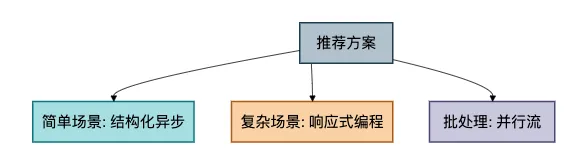
异步编程模式对比
更推荐的方案:
五、内存泄漏:隐藏的资源消耗者
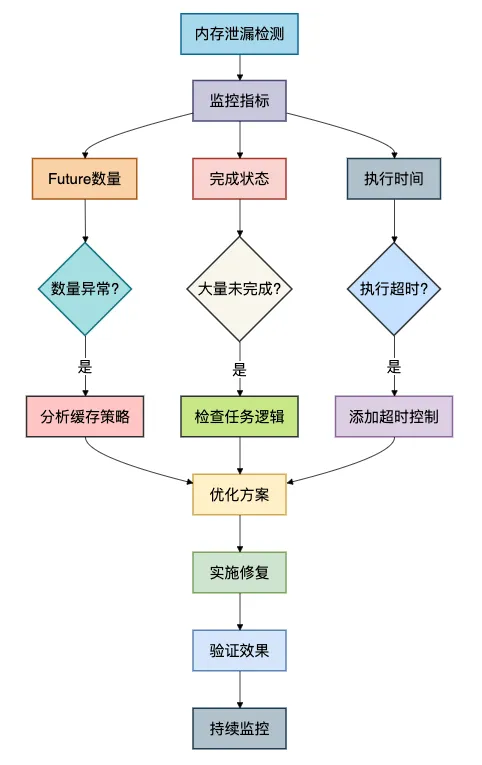
有些小伙伴可能没有意识到,不当使用CompletableFuture会导致内存泄漏,特别是在长时间运行的应用中。
内存泄漏的常见场景
public class MemoryLeakDemo {
private final Map<String, CompletableFuture<String>> cache = new ConcurrentHashMap<>();

// 场景1:无限增长的缓存
public CompletableFuture<String> getDataWithLeak(String key) {
    return cache.computeIfAbsent(key, k -> {
        return CompletableFuture.supplyAsync(() -> fetchData(k));
    });
}

// 场景2:未完成的Future积累
public void processWithUnfinishedFutures() {
    for (int i = 0; i < 100000; i++) {
        CompletableFuture<String> future = CompletableFuture.supplyAsync(() -> {
            // 模拟长时间运行或阻塞的任务
            try {
                Thread.sleep(Long.MAX_VALUE); // 几乎永久阻塞
            } catch (InterruptedException e) {
                Thread.currentThread().interrupt();
            }
            return "result";
        });
        // future永远不会完成,但一直存在于内存中
    }
}

// 场景3:循环引用
public class TaskManager {
    private CompletableFuture<String> currentTask;
    private String status = "INIT";

    public void startTask() {
        currentTask = CompletableFuture.supplyAsync(() -> {
            // 任务持有Manager的引用
            while (!"COMPLETED".equals(status)) {
                // 处理任务
                processTask();
            }
            return "done";
        });
    }

    // Manager也持有任务的引用
    public CompletableFuture<String> getCurrentTask() {
        return currentTask;
    }
}
}
内存泄漏检测和预防
public class MemoryLeakPrevention {
private final Cache<String, CompletableFuture<String>> cache;

public MemoryLeakPrevention() {
    // 使用Guava Cache自动清理
    this.cache = CacheBuilder.newBuilder()
        .maximumSize(1000)
        .expireAfterAccess(10, TimeUnit.MINUTES)
        .removalListener((RemovalListener<String, CompletableFuture<String>>) notification -> {
            if (notification.getCause() == RemovalCause.SIZE ||
                notification.getCause() == RemovalCause.EXPIRED) {
                // 取消未完成的任务
                CompletableFuture<String> future = notification.getValue();
                if (!future.isDone()) {
                    future.cancel(true);
                }
            }
        })
        .build();
}

// 安全的缓存用法
public CompletableFuture<String> getDataSafely(String key) {
    try {
        return cache.get(key, () -> {
            CompletableFuture<String> future = CompletableFuture.supplyAsync(() -> fetchData(key));

            // 添加超时控制
            return future.orTimeout(30, TimeUnit.SECONDS)
                       .exceptionally(throwable -> {
                           // 发生异常时从缓存中移除
                           cache.invalidate(key);
                           return "fallback-data";
                       });
        });
    } catch (ExecutionException e) {
        throw new RuntimeException(e);
    }
}

// 使用WeakReference避免循环引用
public static class SafeTaskManager {
    private WeakReference<CompletableFuture<String>> currentTaskRef;

    public void startTask() {
        CompletableFuture<String> task = CompletableFuture.supplyAsync(() -> {
            return performTask();
        });

        currentTaskRef = new WeakReference<>(task);

        // 任务完成后自动清理
        task.whenComplete((result, error) -> {
            currentTaskRef = null;
        });
    }
}

// 监控和诊断工具
public void monitorFutures() {
    // 定期检查未完成的Future
    Timer timer = new Timer(true);
    timer.scheduleAtFixedRate(new TimerTask() {
        @Override
        public void run() {
            int unfinishedCount = 0;
            for (CompletableFuture<?> future : cache.asMap().values()) {
                if (!future.isDone()) {
                    unfinishedCount++;
                    // 记录长时间运行的任务
                    if (future.isDoneExceptionally()) {
                        // 处理异常任务
                        handleExceptionalFuture(future);
                    }
                }
            }

            if (unfinishedCount > 100) {
                // 发出警告
                System.err.println("警告: 有 " + unfinishedCount + " 个未完成的任务");
            }
        }
    }, 0, 60000); // 每分钟检查一次
}

private void handleExceptionalFuture(CompletableFuture<?> future) {
    // 处理异常Future,避免它们一直存在
    future.exceptionally(throwable -> {
        // 记录异常日志
        System.err.println("任务异常: " + throwable.getMessage());
        return null;
    });
}
}
内存泄漏检测流程
六、超时控制缺失
有些小伙伴在使用CompletableFuture时,经常会忘记设置超时控制,这可能导致线程永远阻塞。
超时问题的严重性
public class TimeoutPitfalls {
// 危险的代码:没有超时控制
public String dangerousGet() {
    CompletableFuture<String> future = CompletableFuture.supplyAsync(() -> {
        // 模拟网络问题导致的无限阻塞
        return blockingNetworkCall();
    });

    try {
        // 如果任务永远不完成,这里会永远阻塞
        return future.get();
    } catch (Exception e) {
        return "error";
    }
}

// 资源泄漏的示例
public void resourceLeakExample() {
    ExecutorService executor = Executors.newFixedThreadPool(10);

    for (int i = 0; i < 100; i++) {
        CompletableFuture.runAsync(() -> {
            try {
                // 长时间运行的任务
                Thread.sleep(Long.MAX_VALUE);
            } catch (InterruptedException e) {
                Thread.currentThread().interrupt();
            }
        }, executor);
    }

    // 线程池中的线程都被占用,无法执行新任务
}

private String blockingNetworkCall() {
    // 模拟网络问题
    try {
        Thread.sleep(Long.MAX_VALUE);
    } catch (InterruptedException e) {
        Thread.currentThread().interrupt();
    }
    return "response";
}
}
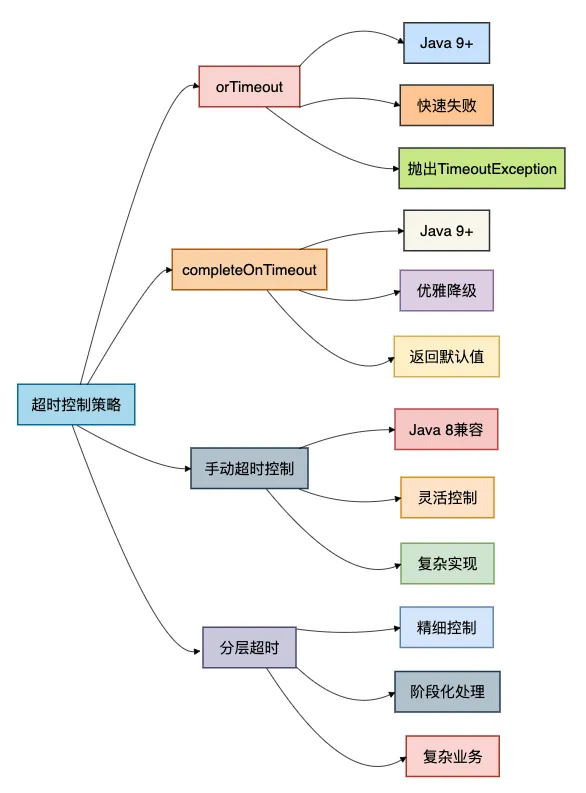
完整的超时控制方案
public class CompleteTimeoutSolution {
private final ScheduledExecutorService timeoutExecutor;

public CompleteTimeoutSolution() {
    this.timeoutExecutor = Executors.newScheduledThreadPool(2);
}

// 方法1:使用orTimeout(Java 9+)
public CompletableFuture<String> withOrTimeout() {
    return CompletableFuture.supplyAsync(() -> {
        return externalServiceCall();
    }).orTimeout(5, TimeUnit.SECONDS) // 5秒超时
      .exceptionally(throwable -> {
          if (throwable instanceof TimeoutException) {
              return "timeout-fallback";
          }
          return "error-fallback";
      });
}

// 方法2:使用completeOnTimeout(Java 9+)
public CompletableFuture<String> withCompleteOnTimeout() {
    return CompletableFuture.supplyAsync(() -> {
        return externalServiceCall();
    }).completeOnTimeout("timeout-default", 3, TimeUnit.SECONDS);
}

// 方法3:手动超时控制(Java 8兼容)
public CompletableFuture<String> withManualTimeout() {
    CompletableFuture<String> taskFuture = CompletableFuture.supplyAsync(() -> {
        return externalServiceCall();
    });

    CompletableFuture<String> timeoutFuture = new CompletableFuture<>();

    // 设置超时
    timeoutExecutor.schedule(() -> {
        timeoutFuture.completeExceptionally(new TimeoutException("操作超时"));
    }, 5, TimeUnit.SECONDS);

    // 哪个先完成就返回哪个
    return taskFuture.applyToEither(timeoutFuture, Function.identity())
                   .exceptionally(throwable -> {
                       if (throwable instanceof TimeoutException) {
                           return "manual-timeout-fallback";
                       }
                       return "other-error-fallback";
                   });
}

// 方法4:分层超时控制
public CompletableFuture<String> withLayeredTimeout() {
    return CompletableFuture.supplyAsync(() -> {
        return phase1Operation();
    }).orTimeout(2, TimeUnit.SECONDS)
      .thenCompose(phase1Result -> {
          return CompletableFuture.supplyAsync(() -> {
              return phase2Operation(phase1Result);
          }).orTimeout(3, TimeUnit.SECONDS);
      })
      .thenCompose(phase2Result -> {
          return CompletableFuture.supplyAsync(() -> {
              return phase3Operation(phase2Result);
          }).orTimeout(5, TimeUnit.SECONDS);
      })
      .exceptionally(throwable -> {
          Throwable rootCause = getRootCause(throwable);
          if (rootCause instanceof TimeoutException) {
              // 根据超时阶段提供不同的降级策略
              return "timeout-in-phase";
          }
          return "general-fallback";
      });
}

// 方法5:可配置的超时策略
public CompletableFuture<String> withConfigurableTimeout(String operationType) {
    TimeoutConfig config = getTimeoutConfig(operationType);

    return CompletableFuture.supplyAsync(() -> {
        return performOperation(operationType);
    }).orTimeout(config.getTimeout(), config.getTimeUnit())
      .exceptionally(throwable -> {
          return config.getFallbackStrategy().apply(throwable);
      });
}

@PreDestroy
public void destroy() {
    timeoutExecutor.shutdown();
    try {
        if (!timeoutExecutor.awaitTermination(5, TimeUnit.SECONDS)) {
            timeoutExecutor.shutdownNow();
        }
    } catch (InterruptedException e) {
        timeoutExecutor.shutdownNow();
        Thread.currentThread().interrupt();
    }
}

// 超时配置类
@Data
public static class TimeoutConfig {
    private final long timeout;
    private final TimeUnit timeUnit;
    private final Function<Throwable, String> fallbackStrategy;
}

private TimeoutConfig getTimeoutConfig(String operationType) {
    switch (operationType) {
        case "fast":
            return new TimeoutConfig(1, TimeUnit.SECONDS,
                t -> "fast-timeout");
        case "normal":
            return new TimeoutConfig(5, TimeUnit.SECONDS,
                t -> "normal-timeout");
        case "slow":
            return new TimeoutConfig(30, TimeUnit.SECONDS,
                t -> "slow-timeout");
        default:
            return new TimeoutConfig(10, TimeUnit.SECONDS,
                t -> "default-timeout");
    }
}
}
超时控制策略
总结
通过上面的详细分析,我们可以看到CompletableFuture虽然强大,但也确实存在不少陷阱。
最后的建议
1.
理解原理:不要只是机械地使用API,要理解CompletableFuture的工作原理
2.
适度使用:不是所有场景都需要异步,同步代码更简单易懂
3.
测试覆盖:异步代码的测试很重要,要覆盖各种边界情况
4.
监控告警:在生产环境中要有完善的监控和告警机制
5.
持续学习:关注Java并发编程的新特性和最佳实践
记住,工具是为了提高生产力,而不是制造问题。
掌握了这些避坑技巧,CompletableFuture将成为你手中强大的并发编程利器!